How To Lose Weight With Surgeries
Sometimes, being overweight can lead to serious health problems. People who are 100 or more pounds over their ideal body weight are more likely to develop medical problems. These problems include diabetes, heart disease, sleep , liver disease, and joint problems.
Weight loss surgery (also called bariatric surgery) can help very overweight people who have tried but failed to lose weight and face serious medical problems. But it's not a quick fix. People need to put in a lot of hard work before and after the operation.

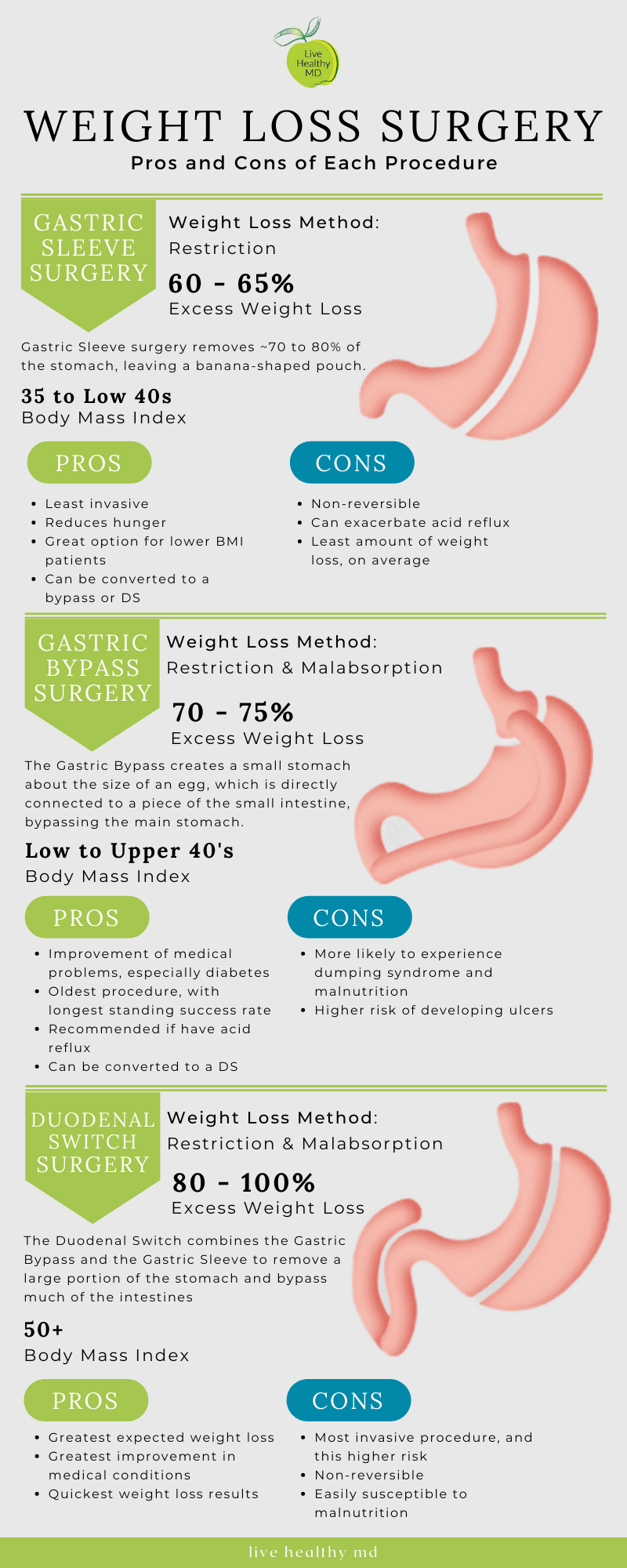
Gastric sleeve (also called sleeve gastrectomy) is the most common weight loss procedure. With this operation, the surgeon removes part of the stomach and makes a tube or sleeve out of the rest of the stomach. The new, banana-shaped stomach is much smaller than the original stomach. Part of the stomach that's removed makes hormones that increase appetite and help control insulin. So, a person's appetite decreases and insulin resistance improves after gastric sleeve surgery.
How To Lose Weight Naturally Without Drugs Or Surgery
After the operation, a person will eat less, feel full sooner, and be less hungry. The gastric sleeve operation only changes the stomach. The gastric sleeve procedure is not reversible.
In a gastric bypass (also called Roux-en-Y gastric bypass), a surgeon creates a small pouch at the top of the stomach. This pouch becomes the new stomach. Surgeons then connect the pouch to the middle part of the small intestine, bypassing the upper part of the small intestine.
After the surgery, the stomach pouch holds a lot less food than a normal-sized stomach. A person will eat less, feel full sooner, and be less hungry. And fewer calories and nutrients are absorbed because the small intestine is shorter.
Choosing A Weight Loss Surgery Procedure
People who get gastric bypass tend to lose more weight than people who get the gastric sleeve, but there can be more problems too. The gastric bypass procedure is not reversible.
Figuring out if an overweight teen can get weight loss surgery requires a team approach. This includes the teen and his or her family, doctors, dietitians, exercise specialists, and psychologists.
Teens must be committed to making the lifestyle changes needed for success and have the support of their families to help them do so.
Weight Loss Surgery Options 2023
Weight loss surgery, like any surgery, does come with risks. People who've had weight loss surgery may have pain, nausea, vomiting, diarrhea, and acid reflux (heartburn) after eating — especially if they eat too much or too quickly.
Dumping syndrome is a problem mainly seen with gastric bypass. This is when food moves too quickly through the stomach and intestines, causing nausea, dizziness, sweating, stomach cramps, and diarrhea. Eating high-sugar or high-fat foods makes dumping worse, so people who have had weight loss surgery need to be careful about what they eat.
Mental health problems, such as depression and anxiety, are a concern before and after surgery. Most people feel better about themselves after weight loss surgery, but some may continue to struggle. It is important for people who have had weight loss surgery to follow up with their mental health professional and get help if they feel overwhelmed or sad, or have other emotional concerns.

What Is The Best Surgery To Lose Weight?
Weight loss surgery is not a quick fix. But the hard work may be worth it for people who are very overweight and have serious health problems because of their weight.
If you're worried about your teen's weight and think he or she may benefit from weight loss surgery, talk to your doctor.A weight loss surgery helps an individual lose weight, eliminating any possible risks associated with carry excess weight. Weight loss surgeries work in varying and distinct ways. This includes restriction, which reduces the number of calories that one can consume by limiting the size of food that the stomach can hold. The other mode is malabsorption, which similarly minimizes the amount of calories and consequent nutrients that the body can duly absorb. This is achieved by shortening some part of the intestine.
This procedure entails placing the duodenal much more distant and further along the ileum. The gall bladder is also removed. This procedure results to very few calories being absorbed by the body from the food consumed. The stomach also secretes very little amounts of hunger-causing hormones, making the individual not to feel hungry fast.
Weight Loss Surgery Has Long Term Benefits For People With Diabetes, Study Finds
The duodenal switch also results to overall health improvement by reducing the risk of some ailments such as cancer after surgery. It is also used to treat some metabolic problems and even diabetes. Most doctors however avoid it, as it is tough and laboring to perform. It consumes more time and requires extensive follow up after surgery.
In biological and technical terms, gastric band is referred to as the laparoscopic adjustable gastric banding. The procedure entails the creation of a small pouch with the use of a gastric band well placed around the stomach. The pouch can be filled by very little amounts of food, limiting the amount of food that one can eat in order to fill it. One feels full very fast, eliminating the need to consume great amounts of food.

The gastric band is fastened after surgery by connecting it to a device placed under the skin, which is at the center of the chest. In order to attain the desired results, the band is tightened severally. This is done to prevent any need of anesthesia by injecting the device with some salt water with the use of a needle through the skin.
How To Lose Weight Before Plastic Surgery
In this procedure, a vast part of the stomach is reduced, making it very small in comparison to the way it was prior to the surgery. Just as with the aforementioned surgeries, one feels full very fast thus massively reducing the amount of food that once consumes.
The now smaller stomach will secrete very small amounts of hormones that cause hunger, making you not feel hungry as fast as you used to be.
Gastric bypass is also known as Roux-en-y gastric bypass. The stomach is subdivided into two parts. A small pouch is created at the top of the stomach with the use of surgical staples. The rest of the stomach is bypassed by directly connecting the pouch to the small intestine. Similarly, it hugely reduces the amount of food needed for one to fill full. This ultimately ensures you consume less food, and thus you will absorb very little calories. Your body shall also absorb very few minerals.
Not Losing Weight After Gastric Sleeve Surgery? Here's A Quick Fix!
Despite this, gastric bypass has a coupling disadvantage in that if one does not adhere to a very good and strict diet, it could cause dumping syndrome or even possible malnutrition.
In contrast to other types of surgeries, intra-gastric balloon is quite temporary, as it is only left in the stomach for a maximum of six months. Your doctor fills the balloon with air and then places into the stomach with the use of a very narrow tube, which goes down through the mouth. The balloon is inflated upon reaching the stomach. It is also vital to note that there exists two types of balloons namely the single and the dual balloon. Your choice depends the size of the stomach plus the results you are looking to achieve.
The aforementioned surgeries all have different advantages and disadvantages. The duodenal switch is the most effective, as it results to much more weight loss followed by gastric sleeve and gastric bypass. Gastric balloon only results to 25-30% of the surplus body weight after a year compared to duodenal switch, gastric sleeve and gastric bypass where one loses around 70% of the surplus weight under the same time or duration. It is therefore vital to do some extensive research and doctor consultations before opting for any kind of the highlighted surgeries.
Which Surgery Helps You Lose Weight The Fastest?
With the variety of weight loss surgeries available, you want to make sure you’re choosing the one that works best for you and your body. The Weight Loss and Wellness Center team can help you. Contact us today to request a consultation, or give us a call at (973) 888-1085.
Dr. Saniea F. Majid, MD, FACS, FASMBS, is our founder, director, and award-winning surgeon with more than 10 years of experience treating patients. She is the former President, and current board member of the New Jersey state chapter of ASMBS, a member of the Board of Directors at New Jersey Doctor-Patient Alliance, and Chair of the Post Operative Weight Recurrence Task Force (POWER). Dr. Majid has devoted her life to helping people like you lose weight and transform their lives and not only started and directed the Metabolic and Bariatric Center at Saint Michaels Medical Center but also achieved the National Center of Excellence. Dr. Majid is one of only three bariatric doctors and surgeons featured in the 2023 Healthy Living magazine published by NJ Top Docs. She is also a former President, current board member, and regular guest speaker for the American Society for Metabolic and Bariatric Surgery (ASMBS) where she trains bariatric surgeons on the latest methods and techniques.
We use cookies on our website to give you the most relevant experience by remembering your preferences and repeat visits. By clicking “Accept”, you consent to the use of ALL the cookies.Cookie settingsACCEPT

Bariatric Surgery Benefits You Besides Helping You Lose Weight
This
Posting Komentar untuk "How To Lose Weight With Surgeries"