Losing Weight Using Bmr
How do you optimize a meal plan? Many factors go into meal planning, such as the type of nutrients consumed, the frequency of meals, and the selective use of fasting, to name a few. But a great place to start is to determine how many calories you burn a day. And it all begins with your Basal Metabolic Rate (BMR).
Certain medical devices also feature BMR as an output of body composition analysis, which will give you a much more accurate BMR measurement than these online calculators. However, there are a few things you should know about metabolism calculations.
Your caloric needs can be calculated with a few different equations, including the revised Harris-Benedict equation and Mifflin-St. Jeor equation. These equations calculate BMR using your weight, with some adjustments for height, age, and sex to give you your BMR estimate. These formulas are often used in the calculators you will find online and in apps.
Find Out How Your Bmi And Bmr Can Help You Lose Weight The Right Way
If you fall outside average assumptions for height, age, and sex (like an athlete), these formulas may not accurately produce your metabolic rate.
For people who fall outside the assumed ranges for height, age, and sex, there is another option: use the amount of lean body mass that you have to determine your metabolic rate. This is the J.J. Cunningham equation.
There are a number of factors that determine your basal metabolic rate, including genetics, age, sex, hormones, and body composition. That means while there are factors that are out of your control, if you focus on improving your body composition, you can increase your basal metabolic rate. Focus on increasing muscle mass to raise your basal metabolic rate.
Bmr: Why It Matters
Remember, your BMR is just the number of calories your body burns at rest and does not account for the calories you need to walk, talk, exercise, etc. When thinking about your caloric needs for a meal plan, you must account for your current activity level or your increased activity level if you plan to exercise more. To do that, convert your BMR to your Total Daily Energy Expenditure (TDEE).
So, let’s take the example of a 171.1-pound male with 133.6 pounds of lean body mass and assume he is moderately active. Using the Cunningham equation, this person would have a BMR of around 1, 679 Cal/day. Multiply that by the conversion, and you get 2, 602.45, which is how many calories this person needs to maintain his weight.
When trying to improve your body composition and body fat percentage, you must reduce fat mass and gain muscle. That’s why it takes a conscious effort to change your body composition.
How To Calculate My Bmr And Tdee
Importantly, this also means that your diet must also match what your current goal is—body fat loss and/or gaining lean body mass. People who don’t calibrate their diet to match their goals end up sabotaging themselves by setting fitness and meal plans that are at odds with each other.
The most classic example is this: “I want to get buff, so I am going to diet (eat fewer calories) and work out more (increase energy expended).”
This isn’t a bad plan—if you’re only looking to lose fat. If you’re looking to build muscle and get stronger, it’s very unlikely that you will reach your goal because you will lose muscle.
Your Guide To Basal Metabolic Rate
There is a lot that goes into any meal plan, and it can get complicated quickly. From a dietary standpoint, you can count on one thing: if you want to lose fat, you need to run a caloric deficit. That means you need to take in fewer calories.
If you’ve found your BMR and converted it to TDEE, you know what your body requires in a day to stay at its current weight. That’s your starting point. You need to consume less than your TDEE if you want to achieve weight loss.

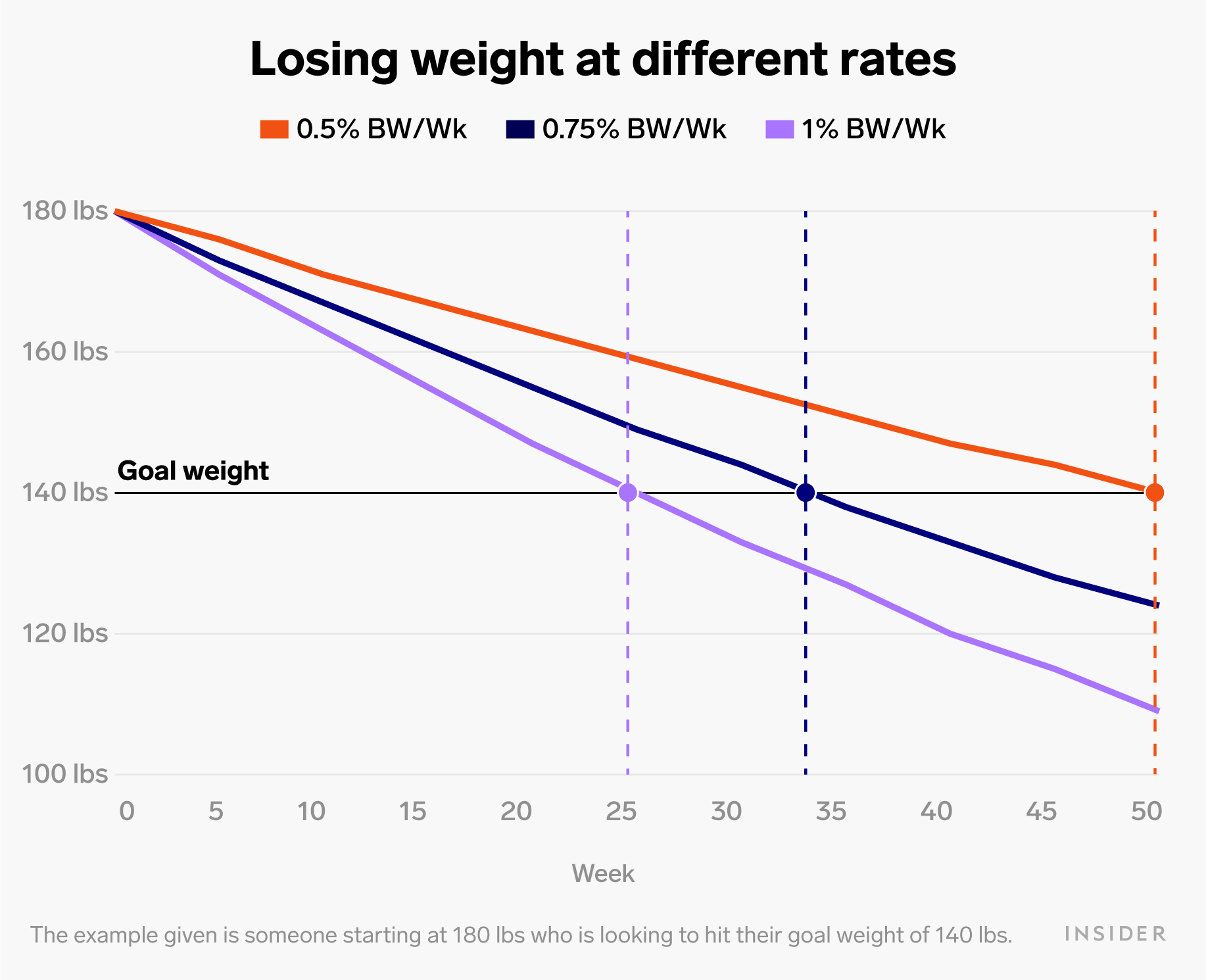
Theoretically, any amount that is less than your normal TDEE can cause you to lose weight; it just depends on how quickly you want to see results.
Basal Metabolic Rate: What Is It And Why It's Important
A lot of resources will tell you that you need to subtract 500 calories from your diet each day to lose one pound of fat per week. This is based on the premise that one pound of fat represents 3, 500 calories, and that by reducing your caloric intake by 500 over 7 days, you’ll reach a weekly loss of 3, 500 calories or a pound of fat. You may have heard this rule before.
However, hard-and-fast “rules” like these are tricky because although they’re usually based on facts (caloric reduction leads to fat loss), they may not be recommended or safe for everyone. Someone with a TDEE of around 2, 600 calories might have to make adjustments to drop to 2, 100, but someone whose TDEE is 1, 400 will probably have significant difficulties living a normal life and exercising while consuming 900 calories a day for any length of time.
The safest way to handle a caloric reduction is to reduce your intake by something marginal—200 or 300 calories a day, for example—and be consistent with this for a week or two. After a week, have your body composition analyzed to ensure you aren’t losing lean body mass. If you see your fat mass drop, you can see by how much and adjust your caloric needs accordingly.
What Is Bmr And Tdee + How To Use Them To Lose Weight
The first thing to do would be to cut any unnecessary snacks and treats in your diet—soda, chips, chocolate, alcohol, etc. Depending on how much of these existed in your diet before, this simple step might be enough to cause you to lose weight without making any other changes!
But what if you were already eating clean? Where do you cut calories on a clean diet? If you’re in this situation, you need to make sure you are cutting calories from nutrient sources that you can afford to cut from. One nutrient group you should not cut too much from (if at all) is protein.

Protein helps ensure your weight loss is fat and not fat-free mass or lean body mass. Find out how much protein you should eat for your body composition here .
Bmr: What Is My Basal Metabolic Rate?
One way to do this from a dietary standpoint is to consume foods that are low in calories but high in protein. Here are a couple of foods to consider:
If your goal is to build lean body mass, you must exceed your daily caloric needs and combine it with strength training.
Start with your BMR and convert it to TDEE by multiplying it by the factor that best reflects the amount of physical activity you have in a week. For the sake of consistency, we will use the previous example (1679 Cal/day) and exercise factor (x1.55) to produce a TDEE of 2, 602.45. This is the number of calories that must be exceeded to have enough energy to produce the desired results.
How Consumption Below Bmr Undercuts Fat Loss
According to research, you need to consume approximately 15% more calories per day than what is required to maintain your body weight (that’s the TDEE). So in this example, this individual should look to increase their caloric intake to about 2992.3 calories, which for convenience’s sake, could be safely rounded off to an even 3, 000 calories/day.
The study cited above suggests that to maximize lean mass gain while minimizing fat gain, the increase in calories should comprise both protein-rich foods and carbohydrates.

However, a word of caution about protein—before you increase your diet with nothing but protein, consider this: there is a point where eating more protein won’t lead to a measurable increase in lean mass. In a 2006 study of collegiate level athletes, no benefit in muscle or strength gain came from protein consumption that exceeded .9 g of protein per pound of body weight.
What Is Bmr And How Can It Help You Lose Or Gain Weight?
While protein is important, caloric intake is arguably more necessary. In the article cited above, the athletes consumed their required protein amount but failed to consume the total amount of calories appropriate for their fitness level, which led the authors to comment:
The low energy intakes observed in this study confirm previous reports that have shown that collegiate athletes rarely meet their nutritional needs, specifically as it relates to energy intake. Caloric intakes of strength/power athletes should exceed 44 – 50 kcal·kgBM·day-1; however, the caloric intakes reported in this study (33.0 ± 5.5 kcal·kgBM·day-1) were below these recommended levels and likely impacted the ability of these subjects to make significant gains in lean tissue accruement.
Bottom line: you need to exceed the number of calories you require each day if you are trying to gain lean body mass, but it is not a free-for-all. Just like when you are trying to reduce your calories, it is important to make conscious choices.
Do You Know How To Calculate Your Basal Metabolic Rate (bmr)?
As with any dietary plan, you want to know how long it will take to see results. Yes, you can just use an online calculator to get a quick snapshot of where your BMR is today, but it won’t be tailored to the changes you are making from your diet and exercise plan.
Remember, since your BMR is closely linked to your lean body mass, any changes will affect the number of calories you burn.

If you gain lean body mass, your energy needs are going
Posting Komentar untuk "Losing Weight Using Bmr"