How Fast Can I Lose Weight If I'M Obese
What if somebody gets demotivated after not seeing any meaningful change out of the gate? What if somebody gets exhausted with the process after yet
Some people simply do better with a faster approach. An approach that allows for more consistent visual change AND a shorter dieting timeline. There are even people who do best with an extremely aggressive approach—an approach that allows for rapid visual change and a very short diet.
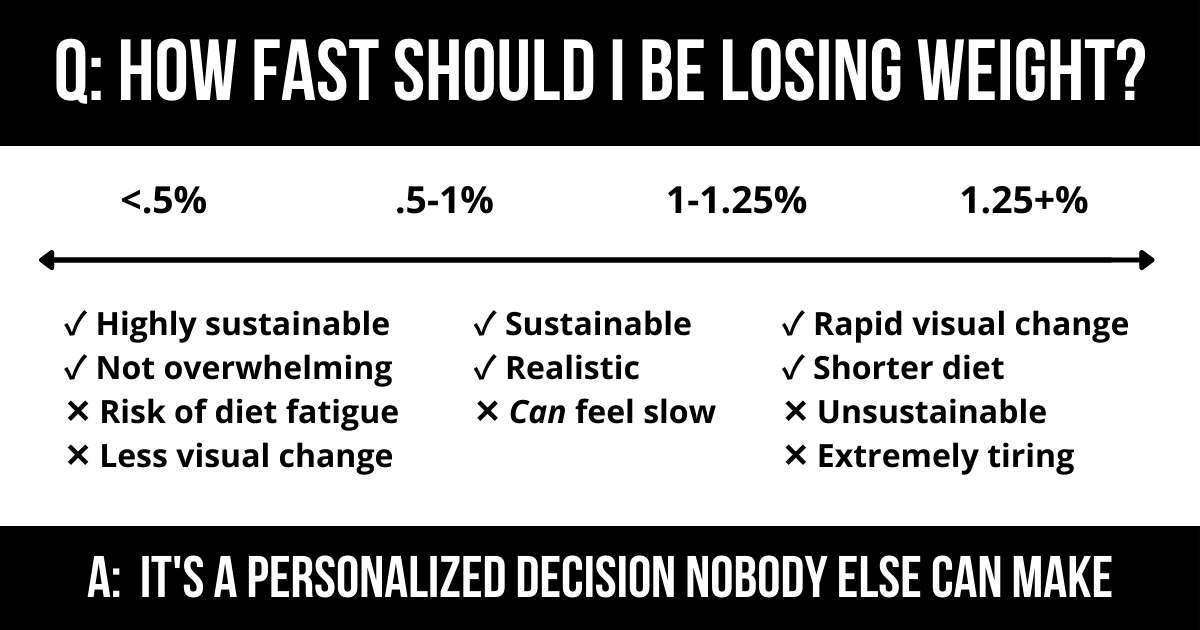
Well, that’s exactly what we’re going to figure out today. To answer the question, “How fast should you be losing weight?”, we need to consider the specific trade-offs of every approach.
How Quickly Should You Lose Weight To Keep It Off?
As you can see, each approach has its pros and cons. So it’s important for us to consider your dieting history, goals, and lifestyle demands before deciding how to set up for your diet.
If you’re 200 pounds and losing under .5% of your bodyweight per week, you’ll see losses under a pound. Most people complain this is “slow, ” but losses of .2, .4, and .7 pounds add up faster than you think.
Take it from my very own mother, who rarely lost more than a pound per week as a client, and radically changed her life (losing 70+ pounds and 40+ inches) in just two years:
How To Lose Weight Fast In 3 Simple Steps
So impatient that they resist this reality, even if it’s the ideal pace for their hunger tolerance, willingness to sacrifice, and overall lifestyle.
Again, increments of .3 and .6 pounds per week add up faster than you think. In just two years (0.03% of the average lifespan), you can lose 30-40+ pounds without doing anything drastic:
All this said, I’m a fan of this approach for a lot of my VIP Nutrition Coaching clients. For others, though, a slightly faster approach is better:
Will I Lose Weight If I Stop Eating?
Slowed to .25-.5% per week (in an effort to NOT be restrictive during the pandemic), then ramped back up to .1% per week in recent months:
At any given time, we’ve chosen the approach that makes sense for his “season of life”—although switching things up on an extremely regular basis isn’t wise, either (I rarely alter a client’s approach more than a few times per year).
The reason I consider this pace “best” for most dieters is simple: it produces consistent visual change, minimizes a diet’s length, and doesn’t require extreme measures.
Reasons It's Harder To Lose Weight With Age And What To Do About It
To lose at this pace, but do practically nothing (consistently) to warrant it—putting them in a position to feel discouraged and frustrated. At which point, they’re left with two options:
Most people are better off choosing the former, and settling for a pace between .5% and 1% per week. This doesn’t drag out the diet, and it’s realistic for most.
That said, there are exceptions, like (A) when people who want to lose a large percentage of their bodyweight, and (B) when fairly lean, advanced dieters are in the mental, logistical, and emotional space to prioritize fat loss to an extreme degree.
How Long Does It Take To Lose Weight?: All You Need To Know
For people who want to lose a meaningful percentage of their bodyweight, the process will be “easier, ” as their maintenance calories are typically higher, and a large calorie deficit won’t necessarily put them in an extremely low calorie target (ex. 1, 200-1, 350).
For others, however, the process can be much harder. Take it from Matt, my longtime friend who came to me with an aggressive fat loss goal and a short timeline to achieve it. I warned him that he’d experience:
IMPORTANT: Whether you’re somebody who’s pursuing a substantial weight loss goal, or advanced and interested in minimizing a dieting timeline (like Matt), you MUST have an “exit strategy*” for an approach this aggressive—otherwise you risk rebounding (hard).
Foods To Eat To Help You Lose Weight
*If you don’t know what an exit strategy is, you almost definitely shouldn’t bother with this approach (unless you’re open to some guidance).
You can combat this by requesting a copy of the Protein Power-Up, my go-to resources for dieters looking to maximize their progress:

It’s worth clarifying that the above considerations are mostly for advanced dieters, and that the “symptoms” of this approach are less intense for people pursuing larger weight loss goals (because of their maintenance calories).
Simple Tips To Make Weight Loss Easier In 2023
✓ If you’re a beginner, highly social, or not overly interested in changing your habits, <.5% per week makes the most sense for you
✓ If you have some dieting experience, want to see fairly consistent visual change, and are comfortable making more sacrifices, ~1% per week is likely a good target
✓ If you’re an experienced dieter who’s able to prioritize fat loss above most other things, OR interested in losing a large percentage of your bodyweight, 1.25+% might make sense for you (IF you have an exit strategy in place)
How Fast You Lose Weight Doesn't Matter If You Don't Learn This One Lesson First — Kmoremacro
With this in mind, here’s how a 200 pound person might set up their diet to lose .5 pounds per week (.25%):
The body is NOT a perfect math equation and weight loss targets are 100% out of our control. This hypothetical calculation does NOT account for a single human element (ex. stress levels and dieting history). It is nothing more than an example of what
Something else to consider is that very few people have maintenance calories of 3, 000. Because of this, deficits over 500 (per day) aren’t typically wise. The trade-offs intensify, and it’s often unhealthy and unsustainable.
Yes! You Can Eat Anything You Want & Still Lose Weight?
Again, there are very few scenarios where I’d recommend a deficit this large—unless somebody had extremely high maintenance calories and an exit strategy in place.
It’s worth repeating that the body is NOT a perfect math equation and these are NOT nutritional recommendations. None of these estimates account for:

So PLEASE do not take these and run with them (it’s a recipe for failure). Use them as a educational reference and nothing more—and let me know if you’d like me to personal them for you in an ongoing coaching dynamic:
Will I Run Faster If I Lose Weight?
Activity levels are in check BEFORE beginning a diet (of any intensity). This elevates your maintenance calories and makes you more likely to maintain your results.
Sam is currently based in New York City with his wife Vanessa, and spends most of his free time brainstorming tattoos, Googling best donuts near me, and figuring out how to eventually adopt as many puppies as possible.You’ve probably heard that a pound of fat contains 3, 500 calories. To lose a pound of fat per week, then, you just need to eat 500 fewer calories per day than you burn (500 x 7 = 3, 500).
If you have 25, 50, or 100+ pounds to lose, losing one pound per week means you’ll be dieting for months if not years .
Can You Lose Weight With Diet Alone: Research And Tips
If you’re very overweight (25+% body fat as a man or 35+% as a woman), you can probably lose a lot more than one pound of fat per week.
In fact, if you know what you’re doing with your diet and training, you may be able to safely lose two, three, or even four pounds of fat per week.
You’ll be more hungry, you’ll have to be more strict about your diet, and you’ll probably need to do some exercise, too.
How Much Weight Is Safe To Lose?
The payoff, though, is that you can lose fat two or three times faster than most personal trainers, dietitians, and weight loss gurus recommend, without risking your health or losing large amounts of muscle.
So, if you want to learn how fast you can safely lose weight when you have a lot of weight to lose, you want to keep reading.

The reason for this is that most of the negative effects of rapid weight loss occur in people who are already fairly lean.
What To Do If You're Gaining Muscle And Not Losing Fat
That is, metabolic and hormonal hobgoblins mainly come out to play in people who are lean and trying to get even leaner, but they rarely rear their heads in people who have a lot of fat to lose.
We don’t need to get into the nitty gritty details, but suffice to say that rapid weight loss is no guarantee of metabolic or hormonal problems. Instead, it’s fast weight loss when you have little weight to lose that causes issues.
In many cases, people who are very overweight are already eating fairly low-nutrient foods, and when they reduce their food intake to lose weight, their consumption of essential vitamins, minerals, and fatty acids plummets . In some cases, they also eliminate whole food groups (grains, dairy, fruit, red meat, etc.), which further increases the risk of nutrient deficiencies.
Weight Loss: If You Have Stopped Losing Weight On Keto Diet, This Is What You Should Know
Thus, an “unsafe” weight loss diet is one that restricts your food intake to the point you’re unable to consume enough essential nutrients to support your health.
You can avoid these problems, though, by getting the majority of your calories from whole, nutrient-dense, minimally processed foods during your diet.
When you prioritize foods like this, you can eat a relatively small number of calories while still meeting your daily nutritional needs. (Taking a good multivitamin is also a good way to fill any nutritional “holes” in your diet).
Can You Lose Weight By Eating Less
Of course, the more you restrict your calories, the more careful you’ll need to be about the quality of the calories you do consume.
That is, if you’re only eating 1, 500 calories per day, most of those calories should come from foods that are as high in nutrients as possible, and you won’t have much wiggle

Posting Komentar untuk "How Fast Can I Lose Weight If I'M Obese"